A Computer Has Zero Judgement
A computer has zero judgement. It simply follows your instructions.
In fact, sometimes I refer to a computer as an obtuse yet obedient child. It will do whatever it is asked to do, but it will never stop and think on its own.
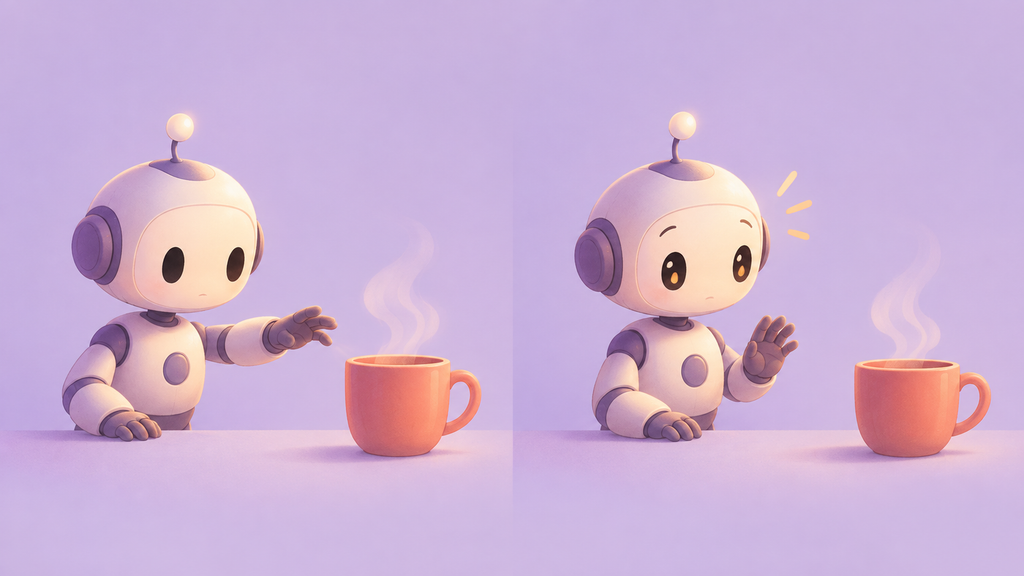
If you ask it to touch a hot cup of tea, it will touch it. It will not look at the situation and think, this is hot, maybe I should not touch it.
Even if its hand has been burnt before, it can still repeat the same action.
But here is the interesting part.
It can learn.
And this is where Artificial Intelligence starts to make sense.
So What Is Artificial Intelligence?
AI is simply the goal of making a machine do things that normally require human-like abilities.
Things like perception, decision making, judgement and recognizing patterns.
We want a machine to do more than just follow a command. We want it to somehow understand what is happening around it and make a better decision based on what it has seen or learned.
That idea is not new.
AI Did Not Come Out of Nowhere
In 1950, Alan Turing asked a very simple but powerful question:
“Can machines think?”
Then in 1956, the term Artificial Intelligence was coined at the Dartmouth conference.
So AI is not something that suddenly came out of the blue in the last few years.
It has been around for decades.
What changed is that now AI has become available to almost everyone. Before this, most people were not directly interacting with AI every day. Today, you can open your phone or laptop and use an AI system within seconds.
But earlier AI worked very differently.
When AI Was Based on Rules
For a long time, we tried to make machines intelligent by giving them rules.
For example:
If the room is dark, turn on the light.
If the room is bright, turn the light off.
Simple.
This is called rule-based AI or symbolic AI.
Some of the bigger systems built this way were known as expert systems.
And this approach works.
But only until the world gets messy.
Why Rules Were Not Enough
Imagine I ask you to write down every rule needed to identify a cat.
You may start with:
It has four legs.
But a dog also has four legs.
Then you may say it has fur.
Again, many animals have fur.
Then maybe you start adding rules about ears, eyes, shape, size, movement and so on.
Very quickly, the rules become endless.
The same problem happens if you want a computer to understand every possible way a person can perform a sign in sign language.
People do not move in exactly the same way every time.
The hand position may change slightly. The camera angle may change. The lighting may be different. One person’s hand may look very different from another person’s hand.
You cannot keep writing a new rule for every possible situation.
The rules simply explode.
Then Machines Started Learning From Examples
Instead of writing every rule ourselves, we started training machines more like we train a child.
Through examples.
Through experience.
Through patterns.
Rather than telling a machine exactly what a cat should look like, we can show it many examples of cats and let it learn the patterns itself.
This is where machine learning comes in.
And there is one very common misconception here.
People often use AI and machine learning as if they mean exactly the same thing.
They do not.
Machine learning is AI, but AI is not machine learning.
AI is the bigger idea.
Machine learning is one way of achieving it.
Supervised Learning
The easiest way to understand supervised learning is this:
You give the machine examples, and you also give it the answers.
For example:
This video = the sign “yes”
This image = cat
This email = spam
The machine looks at many examples and slowly learns the relationship between the input and the correct answer.
This is exactly how many classification systems work.
A sign recognition model is a good example.
You show the model many labelled examples of signs, and it learns to recognize the patterns connected to each sign.
Forecasting can also fall into supervised learning because you are training a model using past examples where the outcomes are already known.
So supervised learning is basically:
Here are the examples. Here are the answers. Learn the connection.
Unsupervised Learning
Unsupervised learning is different.
This time, you give the machine data but you do not give it the answers.
You simply ask it to find patterns.
Imagine a shop has thousands of customers.
Instead of telling the machine:
These are premium customers.
These are discount buyers.
These are occasional buyers.
You simply give it the customer data and let it analyse the behaviour.
The machine may discover that there are five different types of buyers.
Nobody told it those groups existed.
It found them.
That is unsupervised learning.
The machine is basically saying:
Give me the data and let me see what patterns are hiding inside it.
Reinforcement Learning
Then we have reinforcement learning.
This one is more like learning through trial and error.
The machine takes an action.
If the action is good, it gets a reward.
If the action is bad, it gets a penalty.
Then it tries again.
Over time, it learns which actions give better results.
You can think of it a little like training a dog with treats.
Do the right thing, get a reward.
Do the wrong thing, no reward.
Keep repeating until the behaviour improves.
This type of learning is used in areas such as games, robotics and systems where the machine has to keep making decisions.
Three Ways Machines Learn
If all of this sounds complicated, just remember these three lines:
Supervised learning: learn from answers.
Unsupervised learning: find patterns without answers.
Reinforcement learning: learn through trial and reward.
That is the basic idea.
We started with machines that simply followed rules.
Then we reached a point where writing every possible rule became impossible.
So instead of telling machines exactly what to do in every situation, we started teaching them through examples, patterns and experience.
And that shift from writing rules to learning patterns is one of the most important changes in the story of Artificial Intelligence.